
News
Morphor ECHON 6 review: A new dawn for analogue synthesis?
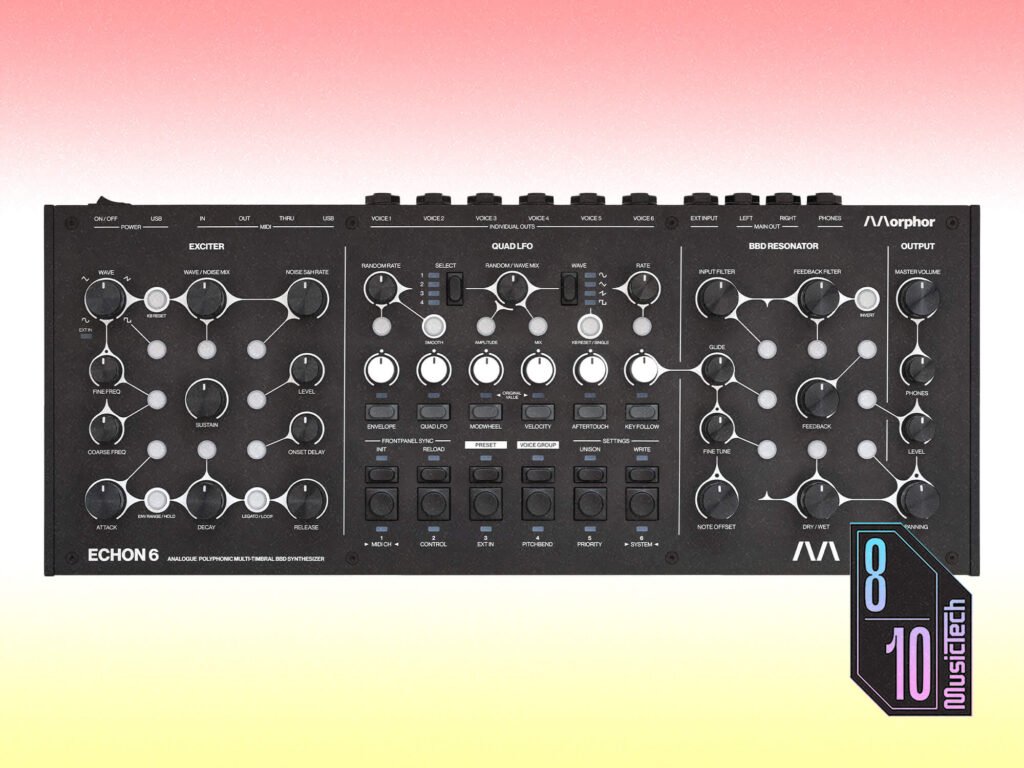

€2,295, morphor.io
To best understand the ECHON 6, you really need to understand Belgium-based developer Morphor. And to best understand Morphor, you really need to understand the sonic wonderland that is bucket brigade delay (BBD). And the best way to understand bucket brigade delay is through the simple (and fun) fact that the series of capacitors in these venerable little analogue circuits ostensibly get their name from old-fashioned firefighting methods, where firefighters would pass buckets of water down a line. If you imagine doing such a thing with any urgency, you might say water would inevitably be ‘slopped around’— or, in electronic terms, be subject to a degree of filtering, both on the way in and way out, and aliasing.
It’s this degree of imperfect ‘sloppiness’ that gives BBDs their unmistakable character. Warm, saturated, noisy, and a tad unstable; it’s everything I love about analogue circuitry. BBDs constitute the heart of a litany of celebrated delay units, from the Electro-Harmonix Memory Man to the highly sought-after Moog MF-104. And it’s what that team at Morphor first congregated around, debuting with the Analogue Plectrum (AP-1) ‘string synthesis’ Eurorack module in 2022. The AP-1 was based on the Karplus-Strong principle, which is essentially the combination of incredibly fast, high-feedback delay lines and filtering to create resonances akin to acoustic sounds.
Since releasing the AP-1, Morphor has more or less devoted itself to harnessing the power of the BBD, and it is precisely this focus that lies at the heart of the ECHON 6. Says Morphor: “ECHON 6 stands as the culmination of that journey, our legacy of BBD research, hands-on analogue craft, and Eurorack design distilled into a fully-fledged, standalone musical instrument.”
It’s the company’s first non-Eurorack design and indeed, declares Morphor, the world’s first polyphonic synth based around analogue BBD resonators. The ECHON 6 has six voices with a discrete BBD delay-line resonator per voice and an all-analogue signal path. It has a phenomenally flexible modulation matrix, a generous raft of inputs/outputs and capacious storage for both presets and ‘voice groups’; that is, a set of parameters particular to specific groups voices within a patch which can— you guessed it— be layered up any which way to be played multitimbrally, or indeed played as separate instruments via different MIDI channels.

The ECHON 6 is simply beautiful. Slim, sleek and modern with a completely flat front panel, it has a similar feel on the table to something like the Torso S-4 or the Elektron Octatrack. It’s weighty, too, encased in sturdy matte-black aluminium and with impeccable build quality. There’s no screen to speak of on the panel (“no display, no distractions,” says the developer), instead a few rows of multipurpose buttons are used to navigate various settings and functions.
Beyond this it’s a near-total hands-on affair, with all sonic controls accessible at surface level. It comes with a pair of rack ears for mounting into the 19-inch format and can also be VESA mounted. Its metallic knobs are firm and smooth, its buttons are tactile and accessible and visually it guides the eye to all the right places. A synth this ergonomic and intuitive feels less like a debut and more like the culmination of decades of standalone electronic instrument design.
The aforementioned I/O consists of a discrete (stereo) output for each individual voice as well as a stereo pair of global outputs and a headphones output, which is a marvellous touch. There’s an input for external audio, USB-C MIDI, and DIN MIDI ports.
Sonically speaking, if you’re used to the architecture of conventional subtractive synths, the workflow of the ECHON 6 might take some getting used to. But once you’re au fait, the whole thing actually becomes incredibly instinctive. It operates across three core sections: there’s the Exciter section, the BBD Resonator section and a central section with controls for modulation and general global navigation.

It goes without saying that a delay effect needs some kind of source audio to, er, affect. Which is to say, a BBD resonator needs something to excite it. The Exciter section is responsible for exactly that, generating the initial sonic stimulus for the resonator section to chew on. At its most basic level this can take one of a few forms. It can be a simple analogue waveform from a traditional VCO, which moves through sine, triangle, sawtooth and square wave shapes (courtesy of the section’s top-leftmost knob). It can be pure white noise, or it can process that noise with a variable-rate sample and hold circuit to create more broken, crackling noise types (adjustable via a knob on the top right). And between these two is a knob to blend between the noise and the simple waveforms.
Noise, I find, is generally made for more flute-like ‘blown’ responses, while a saw wave, for instance, creates more brassy sounds. A sharp, short envelope based on a square wave is brilliant for bright percussion, while an equally short sine or triangle wave forms a good basis for marimba-like tones. Each one is as harmonically rich as I could ever desire!
Beyond these internal sound sources, there’s the aforementioned capacity for external audio to be used as the Exciter signal. This is not so much a bonus feature as an absolute game-changer; opening up new sonic worlds, since it means that more or less anything can be ‘played’ as a resonant polyphonic instrument. I have particular fun sending an Audio.Computer Beat Friend analogue drum machine into the ECHON 6, melodically ‘playing’ its rhythms with a distinctly dirty, piano-like chordal resonance. It can act as a type of vocoder, a guitar effect; you name it.
Beyond these, the lion’s share of the Exciter section is allocated to an envelope, which presents a loopable ADSR design with the addition of a Delay stage. This engages a delay time before the Attack stage. This is particularly handy when playing in a multitimbral patch as it means voices can swell in at different times when holding a single chord, almost like sections of an orchestra.
On the other side of the panel is the BBD resonator section. This is where the feedback network of delay lines lives, the sonic essence of the ECHON 6. At the top of the section are two filters. First is a 12dB-per-octave input filter, which manages the frequency content of the incoming excitation signal. Then there’s the gentler 6dB-per-octave feedback filter, which almost behaves like a conventional low-pass filter. That said, this filter is placed within the feedback loop and not after it, so adjusting it affects the tone while also producing sweeping harmonic shifts as the upper harmonics within the sound lose energy. There’s also a neighbouring Invert button for flipping the polarity of the signal within the feedback loop, altering its sonic character instantaneously.

Then, right in the centre of the BBD section is the Feedback knob. This turns things from order to chaos extremely quickly, and when used in conjunction with the Feedback Filter knob creates visceral, infinite resonances, or short, sharp, pinging responses. This at times means things get out of hand too suddenly for my liking, and on occasion I also find myself wishing for a third filter at the end of the signal chain for a little more control over the synth’s overall tone. This isn’t so much a criticism as a recommendation: an external compressor and filter will get along famously with the ECHON 6! At the bottom of the section is a Dry/Wet knob for blending the Exciter and Resonator sections’ outputs, and a Note Offset to ostensibly manage the tuning relationship between the two by transposing incoming MIDI messages.
The central section of the ECHON 6 presents a detailed modulation section. Modulation and movement is one of the core tenets of this synth, and its 9-by-32 modulation matrix pulls no punches. More than simple oscillations, here modulation means that the ECHON 6 can do things like cycle through different types of harmonic emphasis and more or less change its character completely. Beyond the highly flexible polyphonic Quad LFO, there’s capacity to use the envelope, modulation wheel, velocity, aftertouch or key follower as modulation sources. Programming these is a cinch; more or less all the ECHON 6’s controls have a light-up button next to them to engage modulation of that parameter—I would like to have seen these visually display the movement of their respective parameters, but they are useful all the same.
Whether evoking plucked, bowed or struck responses, the great thing about the ECHON 6’s brand of synthesis is that it doesn’t seek to imitate the sorts of responses one associates with physical surfaces. Instead, it naturally behaves in a similar way. Resonance is resonance, you might say. The woody attack, the harmonic ringing or the metallic reverberation you might hear in this analogue physical modelling synth is no simulation: it’s physics.
There is only really one market competitor I can think of to the ECHON 6, which is the Erica Synths Steampipe. That synth operates with a convergent design broadly consisting of an excitation section and a resonating section, and retails at just over half of the price. But in itself the ECHON 6 is excellently made, its sonic character is as rich and variable as Morphor promised us, and its pure, analogue soul will doubtless stand the test of time.

Key features
- 6-voice analogue physical modelling synth
- BBD Feedback system with full analogue audio path
- 6-part multi-timbral architecture
- 6 analogue VCO exciters with analogue BBD resonators
- Quad LFO + Random generators per voice (24 in total)
- Extensive modulation matrix (9 sources × 32 destination parameters)
- 216 possible presets
- External audio input
- Left/right stereo outputs
- 6 per-voice stereo outputs
- MIDI in, out and thru sockets, and MIDI over USB-C
- Preset management locally or via online configurator
The post Morphor ECHON 6 review: A new dawn for analogue synthesis? appeared first on MusicTech.