
News
Korg Nu:Tekt NTS-4 is a small mixer with big ideas
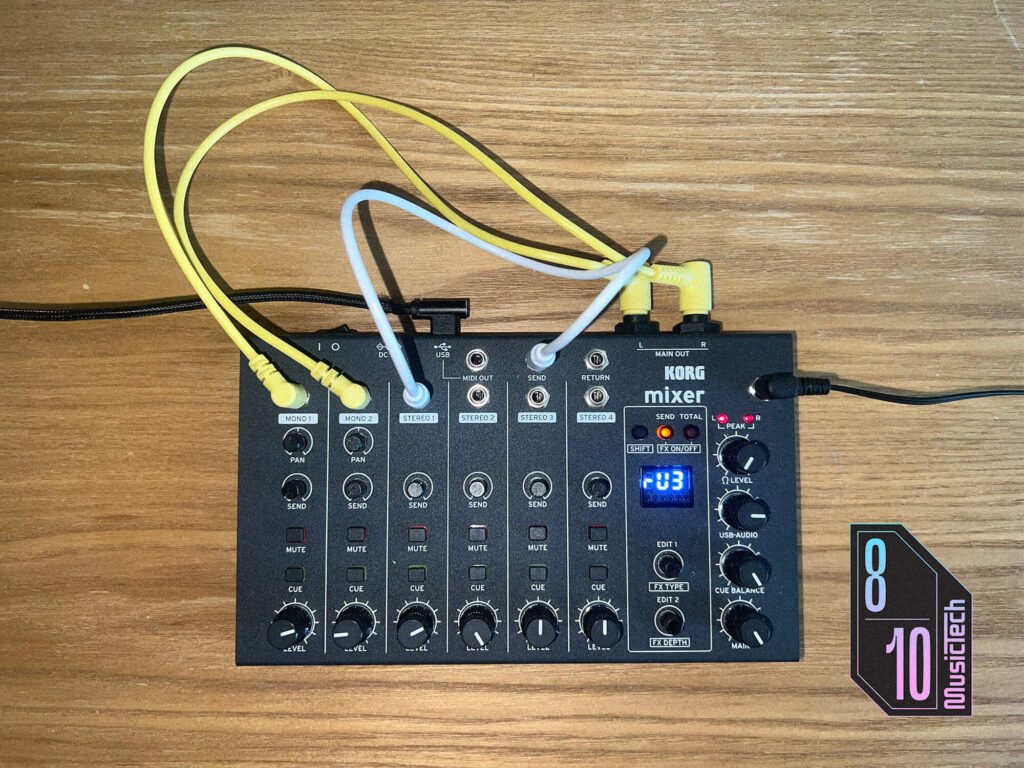

Korg has long had a fascination with small gear. From the Monotron and Volca series to its DIY Nu:Tekt lineup, the company has a knack for squeezing inspiring instruments and effects into almost pocket-sized packages. With the Nu:Tekt NTS-4, the brand has applied that same philosophy to something slightly less glamorous: a mixer.
At first glance, £199 seems steep for the relatively basic task of summing audio. But with onboard effects, cue monitoring, and USB audio/MIDI, could the NTS-4 quietly become the most valuable player of a minimal hardware setup.
Building the Korg NTS-4

Like other kits in the Nu:Tekt range, there’s some preliminary DIY assembly required. The process is simple and enjoyable, taking me roughly 20 minutes, while the notion that I partially built the unit myself creates a small sense of pride and attachment. This is my NTS-4 mixer.

The finished device feels remarkably robust, particularly compared with the more plasticky construction of previous NTS gear. The large Level pots provide enough resistance for smooth volume sweeps, though their proximity to one another means I have to be precise to avoid brushing an adjacent channel. I almost wish Korg had used the smaller Pan and Send knobs throughout; they’re no less accurate, but their size makes them easier to grasp on the control-dense faceplate. The minijacks are the only elements that feel less secure, showing a little lateral play.
Thanks to its 613g weight and rubberised feet, the NTS-4 stays firmly planted, whether I’m twiddling its controls or connecting equipment. It’s visually striking too, its steel chassis in matte gunmetal grey, which dispels any sense that this is merely a toy.
Korg NTS-4 inputs and outputs
Korg has dabbled in miniature mixers before with the four-channel Volca Mix, which—for all its ambition—didn’t offer enough flexibility to extend beyond relatively simple rigs. It’s a different story with the NTS-4, which has two mono and four stereo channel strips capable of handling up to 10 audio signals.
With its minijack sockets, the NTS-4 clearly favours compact equipment such as Teenage Engineering Pocket Operators, Eurorack systems, and Korg’s own Volca and NTS devices. Fortunately, most noise-making gadgets I own have 3.5mm headphone outputs, and I even manage to connect a guitar using the appropriate adapter.
What truly earns the NTS-4 a place in a modest hardware setup is its interface functionality. It’s perfect for recording DAWless jams, and, because it’s class-compliant, can send audio over USB to computers, mobile devices, or even standalone MPCs without additional drivers.
A minor drawback: you can only record the completed stereo mix rather than each channel individually. While that allows for convenient capturing of a performance, multitrack USB recording would have made the NTS-4 considerably more versatile.
Mixing with the Korg NTS-4
To begin, I crank the empty channels to the max. The noise floor is nearly non-existent, with no audible clicks or pops when engaging Mute or Cue.
I connect a Teenage Engineering PO-32 and K.O. II. Input levels must be set on the instruments themselves because the NTS-4 has no gain controls, only an output control for each channel. With peak indicators provided for the Main Out alone, you also need to listen carefully for clipping at the inputs.
Each channel has dedicated Mute and Cue buttons. Cue is particularly useful in performance contexts, routing a signal to the headphones so it can be auditioned before it’s introduced to the Main Out.
Stereo send and return sockets allow external effects to be patched in, although each channel’s Send control simultaneously feeds the physical output and onboard Send effect – the two can’t be adjusted independently.
I discover a makeshift workaround: Cue can route a channel through the headphone output, into an effects pedal and back through one of the stereo inputs. Although, I do accidentally create a feedback loop along the way…

But the accident piques my curiosity. I patch the NTS-4’s Main Out back into its inputs, producing unwieldy, abrasive feedback that can be loosely sculpted with level, panning, and effects.
This is a composition technique called ‘no-input mixing board’, or NIMB, where performers feed a mixer’s outputs back into its inputs and manipulate the resulting feedback as sound. It’s an unconventional use case, but one that may interest sound designers.
Korg NTS-4 effects
Korg has included 17 effects within the NTS-4, suitable for injecting personality into individual signals or spit-shining a full mix.
The first group is fed by each channel’s individual Send control, and includes delays, reverbs, and chorus. At restrained settings, these effects impart subtle polish, but I find them much more interesting when pushed towards their extremes. Care is needed at such settings – it’s easy to accidentally clip the output.
The second group is applied to the summed stereo signal. The Decimator is deft at dirtying up drums, while the filters—once you dial up the resonance—have plenty of bite and work well for transitions.
Editing the effects is straightforward, but the minuscule buttons are not ideal for live performance. Switching an effect on or off requires holding Shift, and the buttons are close enough together to make this two-finger operation feel unnecessarily fiddly.

Previous Nu:Tekt devices such as the NTS-1 and NTS-3 support custom effects through Korg’s Logue SDK and Librarian software. It’s a shame this hasn’t been implemented here, as it would significantly deepen the NTS-4.
Nonetheless, I’m pleasantly surprised by how much can be achieved with its relatively basic toolkit. The effects are a worthwhile addition for hardware jams, taking the NTS-4 beyond mere levelling.
Should I buy the Korg NTS-4?
Before buying any mixer, ask yourself two questions: ‘How much equipment do I need to connect, and is that number likely to grow?’ The NTS-4 has enough inputs for a sizable collection, but its limited routing and outputs may struggle with more complicated setups.
It’s also expensive when basic summing can cost so little. Behringer’s no-frills MX400 four-channel line mixer is just £13, while the eight-input Xenyx 802S with three-band EQ per channel is around £65.
Those competing devices, however, aren’t exactly fun. They’re designed to solve connection problems. The NTS-4 encourages you to play.
While its limitations—mainly the lack of input gain controls and per-channel EQ—keep it from being an instant recommendation, Korg has made a mixer that’s as enjoyable to use as the instruments plugged into it. That distinction more than justifies the NTS-4’s existence, if not quite its price.
Key Features
- 6-channel mixer handling up to 10 audio signals (two mono 3.5mm inputs, four stereo 3.5mm inputs)
- 6.3mm main outs and 3.5mm headphone out
- Per-channel Mute and Cue
- 3.5mm stereo send and return
- Powered by USB-C or 9V adapter
- 7 Send FX and 10 Total FX
- Doubles as a 2-in/2-out USB-C interface with MIDI out
- 7-segment LED display
- Assemble by hand in around 20 minutes
- Dimensions: 195mm x 125mm x 38mm
- Weight: 613g
The post Korg Nu:Tekt NTS-4 is a small mixer with big ideas appeared first on MusicTech.