
News
How a sound-free concert is streaming music to d/Deaf people’s brains

Accessibility in the music industry still has a lot to do to improve the experience for disabled artists, professionals and fans.
While a recent agreement between Live Nation and the Equality and Human Rights Commission (EHRC) will see the ticketing giant improve accessibility at its shows, a report last year by Transreport revealed just over two-thirds of disabled people believe UK venues aren’t equipped to accommodate their access needs.
Supporting the d/Deaf experience in music can include having induction loops at concerts, or attendees wearing haptic vests that help to feel the vibrations of music.
But the “first ever” sound-free concert that took place in May at Kings Place, London, has shown enormous promise that live events could support the d/Deaf experience better. Organised by Tom Staniford and Adrian Webb of technology advisory company OutcomePath, the pair wanted to flip the idea of making a concert equitable for d/Deaf people.
“Those of us who have no disabilities have to stop thinking about disability as bringing everyone up to our standard,” says Webb. “I completely resent that view of disability.”
After two years in the making and getting sponsorship by one of the big cochlear implants (CIs) manufacturers, Advanced Bionics, they produced a concert specifically for CI users to enrich their auditory experience and have music streamed directly to them.
“A CI is just a tool like a phone,” says Staniford. “We were trying to close a paradigm shift of not viewing that tool as promoting equality. It should become a tool for envy.

“It wasn’t about giving the attendees a substandard experience of ‘maybe you’ll hear as well as hearing people one day’. It was about creating this new experience so one day we will have hearing people seeing CI users thinking ‘I fucking wish I had one of those’.”
So, how was it sound-free? Sound waves vibrate in a medium, such as in the air. Your outer ear collects this movement and funnels it to the eardrum, making it vibrate. These vibrations are passed to the cochlea. This turns the vibrations into electrical signals sent to our brain via the auditory nerve endings. With CIs, an electrode is inserted into the cochlea. This bypasses tiny hairs in the ears that would be stimulated by vibrations if you had no hearing loss. Rather than pumping out louder sound into your ear like a hearing aid, CIs convert sound passed through their processor into electrical signals and pump this directly to the auditory nerves in the brain.
Most CIs now connect to devices via Bluetooth. This was how music was streamed in the concert, as hearing aid manufacturer Phonak was brought in to provide the wireless streaming elements, so all attendees were connected on the same channel. Bluetooth transmits using radio waves, and Staniford explains that “human ears can’t hear radio waves; that’s why it’s sound-free”. Webb adds: “Somebody described it as music going directly into your brain, which was exactly the intention.”
But how were the tracks played in the concert sound-free? Music is a pattern of sounds and vibrations made by people and instruments.
Live or recorded music has both vibrated the air at some stage, as it can be listened to or monitored through speakers and headphones. To not vibrate the air as sound waves do, the music was streamed directly to the CIs of the attendees via Bluetooth using GenAI music platforms. No speakers were set up, meaning the room was silent for those with hearing.
Simon Morris composed the music live during the concert on his laptop using GenAI music platforms Suno, Udio and Google Flow Music (formerly known as Producer.ai). Webb explains these platforms use large language models (LLMs) to analyse historical patterns of music.
“If you prompt a country music composition, it will look at the history of the waves of country music that it has been trained on. The AI is looking at the co-occurrence of different waveforms and frequencies against each other. It recreates by almost averaging across them.”
Morris has hearing and was not allowed to listen to the music he was creating. He submitted prompts about the melody, rhythm, instruments and vibes of a song into the GenAI platforms for classical, jazz, EDM and pop genres. Attendees read the prompts on a screen behind him and suggested ideas to him, while he showed them what made effective prompts to generate better music if they wanted to create their own GenAI compositions. Morris made sure none of the music created was pulled from sampling any artists either. And because the GenAI music was never played through speakers, nor recorded, it meant what the attendees heard in the concert was a one-off, as those tracks will never be heard again. Often at concerts, d/Deaf people’s sound quality experience can differ a lot, being impacted by background noise of people dancing, shouting and jostling around, or how far they are from the PA.
Veterinary nurse Skye White attended the concert and has had a CI for six years, after spending most of her childhood with hearing aids after being born deaf. She goes to gigs but can find it hard to listen if she cannot follow lyrics to the music as it “all sounds like a blur”.

Communications officer Charlotte Young wanted to go to the sound-free concert to reconnect with music, after having her CIs for nearly four years following hearing loss over 20 years.
“I have done performing arts all my life, growing up with music and dancing and singing,” she says. “In my hearing loss journey, everything started changing and I became more isolated.”
Staniford knows this feeling too. After being born with hearing, he had moderate hearing loss in his teens before experiencing profound hearing loss in his late 20s that led him to get a CI. As his is made by a manufacturer that wasn’t Advanced Bionics, he could not partake as an attendee in the concert.
What stood out to him, though, was how it brought a sense of community to the d/Deaf attendees.
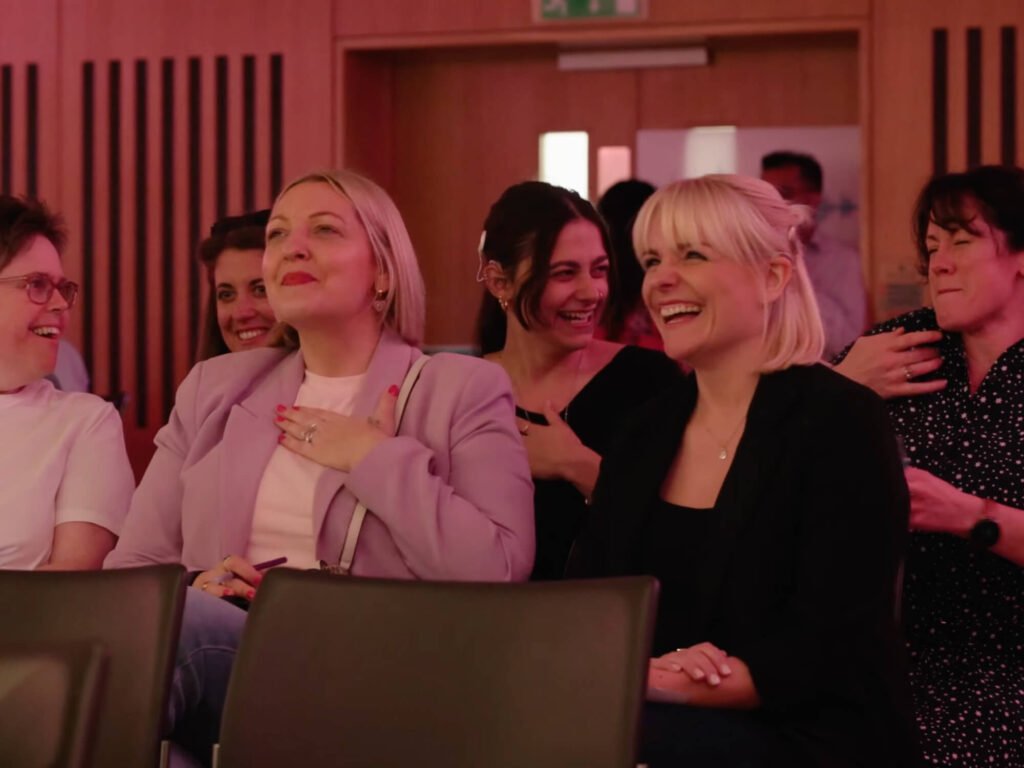
“When everything went silent for me, and I could see all these smiling faces enjoying what they were listening to, it was one of the most psychological, penny-drop moments I’ve ever felt. It was ‘trial-by-fire’, and we needed to show the event was possible. We needed to show it was such a profoundly moving event.”
Young recalls one track reminding her of Frank Sinatra. “We were singing along. It’s mind-blowing for us. We were like, ‘We’re d/Deaf, can hear the lyrics, all laughing together and smiling. What the heck!’.
“It’s always so nice to be in a room with other CI users because it’s quite rare that you tend to meet them in groups. It was a really special moment.”
White appreciated how clear the sound was. “It was really nice to have all the background noise out, hear it really clearly and enjoy it together. It’s just a lot more inclusive.”

Young says it was “surreal” to see hearing people sit in silence and get a sense of “how uncomfortable we feel a lot of the time”, as well as being “the only people in the room to ever hear that music”. White agrees and likes how the concert was a “180” on hearing people being the ones excluded, instead having the focus centred on those with hearing loss.
“Every single day, d/Deaf people are having to fit into the hearing world. We’re always left out. Now they know what it is like for us. To be able to have an event specifically for d/Deaf people, it’s so nice to have our own thing.”
Webb argues the success of the concert has given attendees a superior auditory experience to those with hearing. “It’s pushed the boundaries of people with hearing loss not getting a bit nearer to what we all have, but the reverse that they got something almost clearer, purer and more direct than hearing people ever can.”
Staniford is excited by the prospect of new technology Auracast being rolled out further, as it could enable more concerts like the sound-free one. It’s a version of Bluetooth LE which allows high-quality audio to be broadcast by one device and picked up by an unlimited number of receivers.
“It basically offers universal streaming,” says Staniford. “So, a few years down the line, you could essentially do a sound-free concert supported by Auracast and welcome every CI user.”
Young says having Auracast introduced more widely at venues would be “game-changing” and White says she would go to more concerts if this technology was embraced by the live music sector.
Staniford and Webb are keen to do the concert again. They are analysing the questionnaire responses from the attendees to hopefully publish a white paper on what they achieved and how it can be developed.
“There’s been a lot of interest from big global CI and audiology conferences and organisations,” says Staniford. “We couldn’t do this if we welcomed every CI user. It was a conscious choice that for the first event we deliberately had to make it quite exclusive to be able to do these things.
“Now we’ve done it and shown it’s possible, it’s about expanding it to other cities, people, and audiences. Look at how we’ve created this experience that allows CIs to be considered tools of envy rather than equality. Look at how we’ve revolutionised how people think about music appreciation.
“Now we’ve done it. That’s how you expand inclusion.”
The post How a sound-free concert is streaming music to d/Deaf people’s brains appeared first on MusicTech.