
News
UJAM Symphonic Elements delivers the Hans Zimmer sound straight to your DAW but there are strings attached

£608 as a bundle / £217 each, ujam.com
The UJAM Symphonic Elements series poses an interesting question: what happens when a Hollywood composer opens their once closely guarded toolkit to everyone? The answer comes in a collection of plugins that aims to deliver the signature Zimmer sound in a phrase-based workflow quickly and intuitively, and at a fraction of the cost of a more conventional orchestral sample library.
Firstly, it’s worth making clear from the outset what Symphonic Elements isn’t. This collection is not trying to compete with the enormous orchestral libraries that demand an intimate knowledge of Native Instruments’ Kontakt, expression automation, orchestration and articulations. Instead, it’s a far more streamlined proposition, designed to let producers of all backgrounds and experience dive straight into composing with virtually no learning curve. User interfaces are clean, user friendly and most importantly, consistent across the entire range. Learn one plugin and you’ve effectively learnt them all.
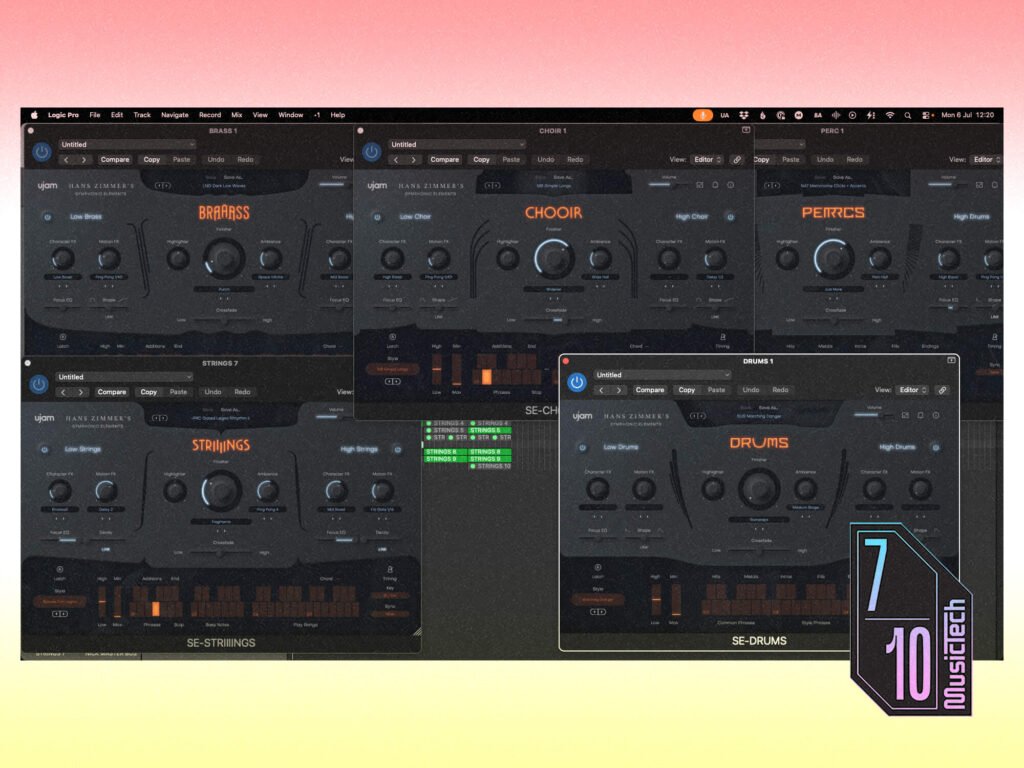
The lineup will come as no surprise: PERRCS, STRIIIINGS, BRAAASS, CHOOIR and, finally, DRUMS (sadly not DRUMMMS). Zimmer himself describes them as “starting points” and “little Legos” that you’re able to load up to get ideas moving as quickly as possible. The concept is immediately obvious once you start playing these instruments. They are really fun to use and it doesn’t take long to feel inspired and start laying parts down.
Cursory inspections over, it’s time to see how they perform in a real composition situation. Feeling suitably brooding, I decide to build a slow burning cinematic cue, à la Mr Zimmer. I begin with STRIIIINGS. There’s no shortage of phrases and styles here, and the overall sound is immediately impressive – the phrases in all these plugins are refreshingly contemporary, and there is a well-organised mix of traditional and hybrid sound sets, all clearly labelled using intuitive menus. I find myself having so much fun flicking through presets that I almost forget I’m supposed to be writing something.
Fortunately, alongside the more cinematic motifs are plenty of simpler building blocks, including ostinatos and repeated staccato patterns that slot easily into a cue. One feature I particularly like is the ability to separate the high and low parts of each preset.. You can enable or disable them independently, or use the DJ-style crossfader to blend between them, making mixing and automation feel musical and expressive. At times, there are mid range elements that are baked in with sounds in the high and low spectrum. Some more control over these would be genuinely useful, but it’s not a feature that’s forthcoming or planned. These plugins favour simplicity over deeper editing, which is an easy decision to respect, even if it can sometimes leave you wanting a little more autonomy. Each engine also has its own EQ and effects controls, so it’s easy to keep the low strings dry and focused while washing the upper phrases in reverb or delay, for example. There is also a nifty macro Finisher function which affects the sound as a whole and can add extra sonic interest, ranging from subtle and musical to wild and chaotic. These are all super useful features that are consistent across all five plugins in the collection.

Next, I want to add beefy low end, so I move over to BRAAASS. There are impressively authentic phrases here alongside the trademark menu of braaams that Hans Zimmer has become famous for. Once again, they sound massive, but sometimes there’s a little too much activity in the sounds, and I find myself frequently dialling back the effects and processing to play nicely with the other elements in the mix.
In fact, one of the main issues I discover from writing an orchestral cue from the ground up with this collection is how presets interact with each other sonically. There are plenty of options to reduce processing and reverb on the phrases here, but once I start layering sounds and parts, it doesn’t take long for things to start competing. The sounds are so commanding and characterful that it can be difficult getting them to sit together in a mix.

Where the collection really shines is less in the melodic phrases and more in the atmosphere and depth found in the simpler rhythmic patches. The gated strings in particular add instant vibe.
Most of the material in DRUMS and PERRCS is also excellent. These collections consistently deliver huge cinematic energy with little effort, and CHOOIR sounds convincing straight away – especially the dramatic hits, shouts and short phrases that add Carmina Burana levels of depth to a track. Combine all these elements together, and you’ve got a fantastic toolkit for building scale and emotion without too much trouble.
The phrase-based approach is probably the biggest sticking point here and will no doubt divide the crowd. It’s brilliant when you’re sketching ideas, but it can become quite frustrating when you start to hear something specific in your head. You can get incredibly convincing rhythmic developments when you use the available key switching in the lower octave to develop and adapt these parts. They trigger six variations of the phrase, generally increasing in intensity as you move up the keyboard, with a final key providing a handy clean ending note. This can lead to really musical results, but the minute you want a slight bend on a phrase or to change one note of melody, you come up against an immovable barrier and have to settle for something that is just close enough. Ultimately, the speed versus flexibility becomes a frustrating trade-off.

That’s not really a criticism of the plugins themselves. It’s just the compromise that comes with phrase-based composition. The software does a lot of the hard work for you, but in return you lose some of the flexibility you’d have with a more traditional orchestral library.
That said, Symphonic Elements occupies a unique space. It’s rare to find sounds this polished at such a competitive price housed within their own plugin. Sonuscore’s The Orchestra Complete is probably its closest rival, but it offers a more traditional orchestral sound pallette. Heavyocity’s NOVO & FORZO are also excellent alternatives, but they’re significantly more expensive and both require Kontakt.
Rather than seeing Symphonic Elements as a complete orchestral solution, I see it as a creative toolkit and that is where we think this collection actually shines brightest – outside of traditional orchestral writing. Instead of relying on it to create full cinematic scores, I find it much more enjoyable as a way of adding orchestral colour and cinematic flavour to other genres. Whether it’s layering strings into electronic music, adding drums to a heavy rock track, or dropping brass into a trap beat, these plugins make it really easy to add convincing orchestral elements extremely quickly. For me, that’s where this collection really stands out from the crowd.

Key Features
- No Kontakt required (uses UJAM’s own Gorilla Engine)
- Unified interface across all five plugins
- Dual phrase engine allows splitting of high and low phrases
- Keyswitch-based phrases with alternative parts and endings to allow on-the-fly composing
- Detailed preset browser with intuitive labelling
- Generous effects and processing options for both layers
- A mix of traditional and hybrid sounds
- Macro style one-knob Finisher tool adds instant character to your sound
The post UJAM Symphonic Elements delivers the Hans Zimmer sound straight to your DAW but there are strings attached appeared first on MusicTech.