
News
How not to make an organ album, according to Michael Cloud Duguay
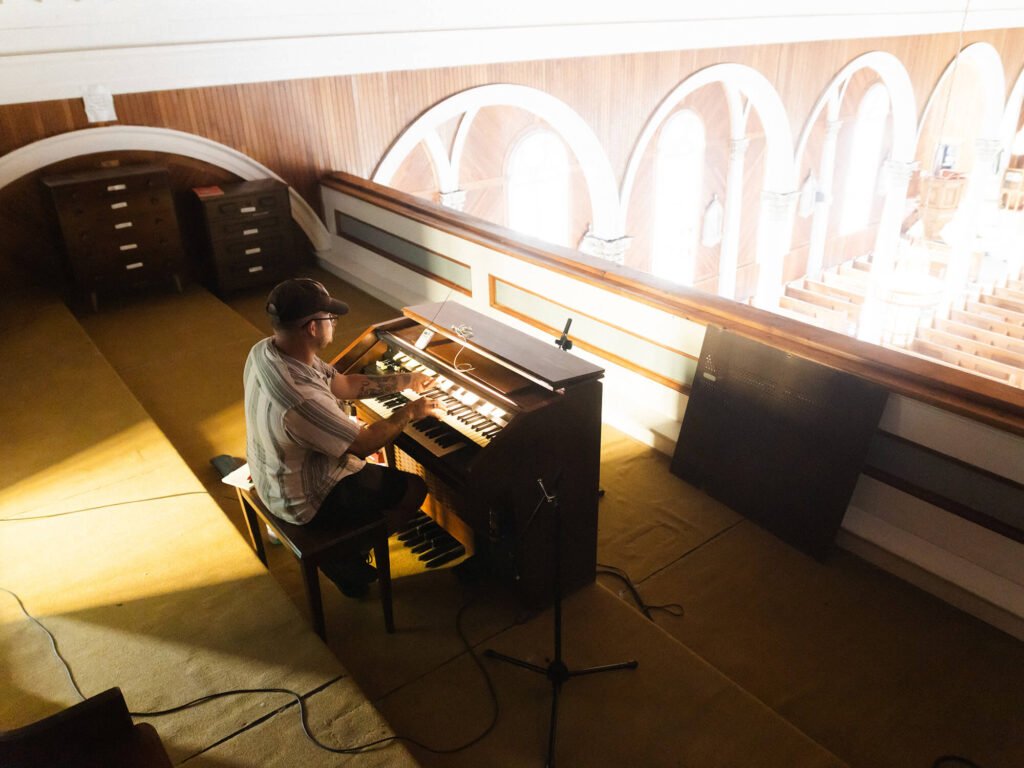

Last summer, composer and producer Michael Cloud Duguay embarked on a ten-day, 1,000-mile journey around Newfoundland, Canada, to record seven historic church organs for his album Kingdom Come, Kingdom Go…which is specifically not an organ record.
“We didn’t want to make an organ record. We wanted to make a record of making an organ record,” Duguay explains.
- READ MORE: Can Jamstik finally make MIDI guitar stick?
When listening to Kingdom Come, Kingdom Go, this separation is clear. There are only brief moments that fit the instrument’s pious reputation. More often, the organs evoke unstable ambient textures. There are also deeply industrial moments, emphasising the intricate metallic parts that must operate precisely for these centuries-old instruments to produce any tones.
Besides, if they were going to make an organ record, Duguay would need to know how to play the organ. But the first time he touched one was when they stepped inside the first church in Brigus, Newfoundland.
“[Kingdom Come, Kingdom Go] is a document of a composer and a performer interacting and engaging with these instruments for the very first time,” Duguay says.
Alongside Duguay on this journey was Jake Nicoll. He’s a musician and engineer who built the solar-powered mobile studio, The Scamper, which they used to record the organs (he also built a bunch of other stuff, but more on that shortly).

Nicoll had never touched a pipe organ either, but the combined lack of experience from both the composition and production side allowed them to approach the instruments with complete freedom.
“It reminded me of my experience playing punk when I first started playing music. I didn’t experience inhibition at that age. I would just throw myself into the fire and start playing with the tools that I had,” Duguay says. “These instruments are very often performed by people with a high level of institutional training. So me bringing [punk] to the instrument results in sounds that I may have been told I shouldn’t be trying to produce.”
Duguay and Andrew MacKelvie, the other composer on the trip, had written all of their pieces before setting off. So they didn’t have any idea how they would translate to the organs, especially since all of the organs were in completely different states.
Some were well maintained. Others hadn’t been played in years. They also had completely different functionalities. One required a hand pump to push the air in to make any sound. Another used pedal pumps, so they were basically riding a bicycle while they were playing.
As Duguay was reaching out to each church in advance of recording, many in the church’s communities warned him about the state of the organs, but all that did was excite him even more.
“They were like, ‘We can’t really speak to how well this can be played on.’ And then there would always be this funny conversation where I’m trying to let them know that, not only is that not a problem, that’s actually motivating,” Duguay says. “These are instruments that have lived for over a century in these giant wooden structures.”

In this unpredictability, they infused the same spirit into the music. Many of the compositional choices were made by literally rolling dice. When they arrived at a new church, they would take the compositions they hadn’t recorded yet, roll dice to choose which one to work with, and go from there. They would even alter elements of each piece, such as octaves and melodies, by rolling dice.
“This was really an exploration, technically, conceptually, practically, logistically, of our DIY backgrounds,” Duguay says. “Pushing that sort of ethos as far as we could at all times.”
The recording process was completely DIY as Nicoll constructed almost every element himself. He built The Scamper out of an RV from the 1970s. He built the console into which the audio ran. He built many of the microphones himself (“I’ve had a DIY mic obsession for the last couple years,” Nicoll says), and he used cymbal stands to build the 30-foot mic stands they used to record the massive organs.
“We didn’t have a budget to spend thousands of dollars on a fancy mic stand,” Nicoll says. “I built it out of telescoping paint poles with an aluminum cross beam. They ended up kind of fittingly looking like very tall Jesus crosses.”
Nicoll mentions that they could spend a week grabbing different sounds from one organ, but they only had one day at most with each. Plus, the configuration for each of them was different. All of them were built into the structure of the church, which means the pipes could be spread out in endless different ways.

So, when it came to mic placement, they would have to figure out then and there how to grab the best audio. For some organs, it was easier to record close to the pipes. Others had mechanical quirks like the hand pump that they wanted to grab.
An overarching element was relying on Lom omnidirectional room mics to not only capture the sound of the organs, but how they sounded in each church. They also used them to grab impulse responses from each room so they could apply natural reverb in post-production.
Needless to say, when it came time to convert what they were able to record on this journey into a fully-formed album, they had a lot to work with. If they were setting out to make an ‘organ’ album, they would have likely done one piece per church. Instead, some pieces have one organ. Some have two. Some have all of them.
Little Seldom came together because at one of the churches they ended up doing a public performance. That material was more digestible, and so they brought together more conventional material from all the sessions into one. Damnable Island has all seven organs playing the same note at once. Due to their different conditions, each instrument was out of tune in its own unique way, creating an acoustic rendition of a phase shifter.
Then, throughout the album, there are moments of interviews Duguay conducted with members of each community about the history of the organs, and also the sound of the different clocks in each church that were so loud they were impossible to keep out of the recordings.
“On Damnable Island, when Dave and I were editing it, we zoomed in, listened to the clocks on each piece, and lined them up like a metronome across every single drone to get them all in place,” Duguay says. “That’s how we determined how to edit that piece. Taking the characteristics of each space to guide that process, which is both editing and composing.”
Their intention was to make a record of making an organ record. The clocks. The interviews. The hand pumps. Even other audio, such as environmental sounds when they were riding the ferry from Fogo Island. They’re all part of the journey. And now, the environmental element is fueling the free VSTs Nicoll is currently designing from the trip with the help of Decent Sampler.
For example, because they have all the impulse responses from the churches, users can apply the reverb from each different church as well as the notes from each organ, which all have their own individual modulations that the team engaged with when making the album.
“With the record, [we were] doing everything we could to not disembody these instruments—not remove them in any way, sonically, from the space that they were in,” Duguay says. “This sampling project allows us to quite radically disembody them. Things like being able to hear the Brigus Island church organ without the pump sound. Until this moment, it has literally never been heard without the pump sound. We can get so granular with these nerdy details, but at the same time, it’s this huge, infinite subject that we can continue to explore indefinitely.”
The post How not to make an organ album, according to Michael Cloud Duguay appeared first on MusicTech.